What to decide about representation, permissions, multilingual review and continuity before avatar production begins.
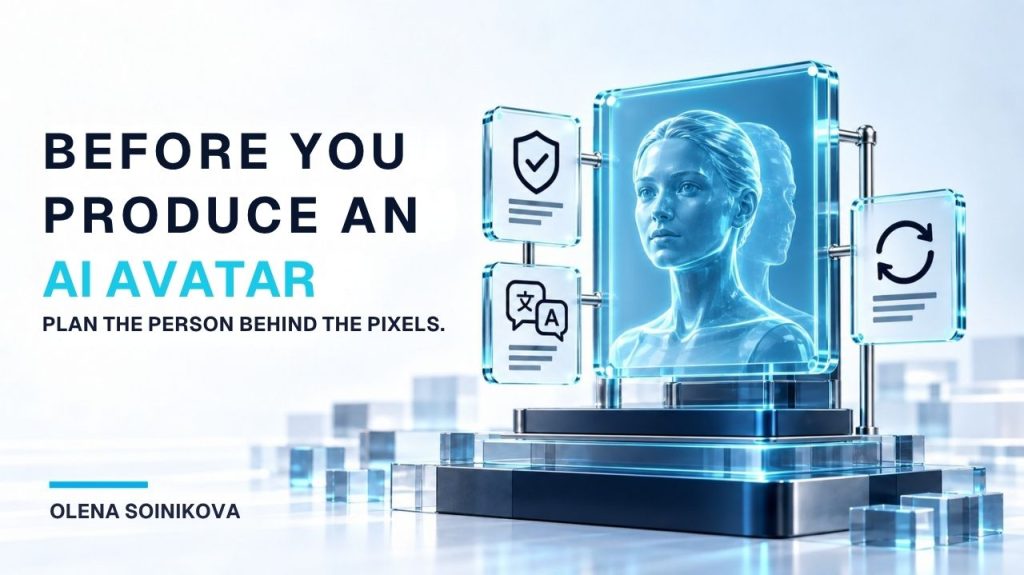
Olena Soinikova · Research & field notes ·
A few months later, the team needs the same message in four other languages. A partner asks whether it can use the avatar too. Some information in the original video needs updating. Then the person whose face and voice were used prepares to leave the organisation.
This is usually the point when the interesting questions begin. Who can create another video, what can the avatar say, who checks the translations, does the original permission cover a partner organisation, and what happens to existing videos after the person leaves? If the organisation changes its AI platform, what exactly can it take with it?
These are decisions about representation, trust, responsibility and continuity.
For organisations using AI video across several projects or languages, an avatar is becoming more than a production shortcut. It can become a reusable communication asset that continues to speak on behalf of an organisation long after the first video has been published.
That changes the planning considerably.
The obvious advantage of an AI avatar is production.
A traditional video connects the message to a recording session. If the script changes, somebody may need to record again. Another language means another version. Six months later, a figure changes and part of the process starts again.
An AI avatar separates the presenter from that recording session. For training, project explainers, recurring information and multilingual content, this can be genuinely useful.
I see the relevance particularly clearly in European project environments. One organisation may need to explain the same programme or service to audiences in several countries, while the communication budget was certainly not designed for separate filming in every language.
This production advantage should not be confused with communication effectiveness.
Research in educational settings has found comparable learning outcomes between AI-presented and human-presented video in some contexts, while participants can still prefer the human experience. The evidence does not give organisations a universal rule about which presenter works better.
The task matters more.
A recurring explanation of how a programme works has different requirements from a personal testimony. A training module is different from a leadership statement. A routine update that needs to exist in six languages has little in common with a message whose value comes partly from the fact that a particular person chose to deliver it personally.
Sometimes an organisation needs a presenter. Other times it needs the presence of an actual person, and better visual realism cannot decide between the two.
HeyGen is a useful example because the platform shows how much the idea of an AI avatar has expanded.
I work with HeyGen and am a HeyGen Ambassador. This gives me a close view of the production possibilities, but I am increasingly interested in what happens around the technology once organisations start using it regularly.
The original proposition was straightforward: provide a script, select or create a presenter and produce a video without arranging another filming session.
The current model goes much further. HeyGen includes stock avatars, photo-based avatars and Digital Twins created from real people. A Digital Twin can reproduce a person’s appearance and voice for new scripts. The same production environment can also support multilingual video and localisation across more than 175 languages and dialects.
At that point, the avatar is doing something more significant than replacing a filming session.
A recognisable digital version of a person can be reused for new messages, updated without another recording and presented to audiences who speak different languages. That is a new capability for a communication team.
It also shifts some of the work.
Once a Digital Twin exists, somebody needs authority to use it. Future scripts need an approval route. New languages introduce new reviewers. A change in the person’s role may change what the avatar should represent.
HeyGen provides the production capability. The organisation has to decide how that capability fits into its own communication system.
The better these tools become, the more relevant that distinction becomes.
The distinction is particularly important when an organisation moves from a stock presenter to a digital version of a real person.
A stock avatar represents no employee in the organisation. A fictional character can be given a defined communication role. A digital likeness of a CEO, trainer, project manager or expert carries an identity that already exists outside the platform.
Once that likeness has been created, a new appearance may no longer require a new recording. Someone prepares the script; the system generates the voice and image; the digital version of the person delivers words that the person did not personally record.
For routine production, that is extremely convenient. It also changes what approval means.
Approval of the original recording is one decision. Permission to generate future messages is a much broader one.
Over time, the difference matters. The employee may change position. Another project may want to use the avatar. A partner organisation may ask to include it in its own communication. The next script may cover a subject that was never contemplated when the avatar was created.
There is an audience dimension too. A digital likeness can imply expertise, personal involvement or endorsement. If an avatar of an expert describes an experience the real person never had, better lip-sync will not solve the problem. The issue is representation.
I therefore find it more useful to treat a real-person avatar as a reusable identity asset, with a video being one possible output from it.
Language is one of the strongest practical reasons to use AI avatars.
One presenter can potentially deliver the same core content in English, Greek, Danish, Ukrainian and many other languages without separate filming for every version. HeyGen’s current multilingual capabilities show how far that technical barrier has moved.
For European organisations, this is substantial.
But there is a gap between having a language available in a menu and being ready to communicate in it.
The platform may support dozens of languages. The organisation still needs somebody who understands language number 17.
A translation can be technically correct and still mishandle a programme name, specialist term or local expression. Acronyms and place names are easy to pronounce badly. A sentence that sounds perfectly natural in English can become strangely bureaucratic elsewhere.
Once published, it is the organisation’s message. The audience is unlikely to assign responsibility to the translation engine.
A practical multilingual workflow therefore still needs a master script, someone responsible for terminology and a reviewer capable of judging each important language. A short sample before full production can catch problems while changing them is still inexpensive.
This is an important distinction in the economics of AI video. The cost of generating another language can fall dramatically without the responsibility for that language disappearing.
Trust in AI avatars is often reduced to disclosure: will people know that the presenter is synthetic?
The real issue is broader.
For a procedural explainer, the audience may mainly need accurate information presented clearly. A personal story, testimonial, sensitive announcement or leadership message carries a different expectation. In those cases, the fact that a real person personally delivered the message can itself be part of what the audience is evaluating.
Current research does not justify a simple rule that audiences trust or distrust AI avatars. Context, purpose and audience matter. So does transparency.
Since 2 August 2026, Article 50 of the EU AI Act has applied transparency obligations to certain AI-generated and manipulated content, including deepfakes. This should not be simplified into a claim that every AI avatar is automatically a deepfake. The legal definition, the content and the circumstances of publication matter.
There can also be requirements from platforms, clients, funders or individual projects.
For communication teams, this belongs in pre-production. Discovering a disclosure requirement after thirty videos have been produced is an unnecessarily expensive way to read the rules.
Real-person avatars bring rights and data questions into what can initially look like a straightforward video brief.
The organisation needs to know what the person has actually agreed to: the intended channels, languages, duration and scope of use. It also needs a workable answer for changes later.
If the person leaves, existing videos may still be online. If permission changes, somebody has to know which assets are affected. A partner may want to reuse a video without having any right to create new material from the underlying avatar.
Data protection is another layer. Under GDPR, describing every photograph, facial recording or voice recording automatically as special-category biometric data is too broad — the processing and its purpose matter. A permission form for someone’s likeness should therefore not be treated as a complete data-protection assessment where further analysis is required.
Platform terms introduce a separate distinction.
The finished video, account, scripts, source materials and underlying avatar are not necessarily controlled in the same way. Downloading a finished video does not automatically mean that the organisation can export the avatar or move the whole production setup to another provider.
These questions can feel rather theoretical during the first production.
Video number two is where they become operational.
AI video can make information easier to distribute. Additional languages can be produced faster, material can be updated without organising another shoot, and captions or transcripts can become part of the workflow.
The resulting video still needs to work for the people expected to use it.
Captions require checking, particularly around names and specialist terminology. Information shown only visually may need another form. A video also has to work in the actual publication environment, including mobile devices and situations where viewers have no sound.
For public-interest and EU-funded communication, I would define these requirements in the brief.
Otherwise accessibility tends to appear at the end as another set of corrections, often when the budget and deadline have already become much less flexible.
The first avatar video can be surprisingly easy to produce. The second one is more revealing.
Someone needs to find the approved script. A date has changed. A new language has been requested. The colleague who checked the original translation is no longer available. Nobody remembers which account owns the avatar. The contractor who produced the first video has finished the project.
These are ordinary operational problems created by a new type of asset.
They also qualify some of the claims about AI making video dramatically cheaper. Generation can certainly become faster. Review, localisation, accessibility, approvals and maintenance remain real work.
An organisation that intends to use an avatar repeatedly therefore needs some continuity around it: where approved scripts are kept, who can generate new versions, who approves them, how language versions are tracked and when outdated videos should disappear.
There also needs to be an exit route. If the supplier or platform changes, the organisation should already understand which assets it keeps and which parts of the system stay behind.
The avatar may last longer than the project that paid for it.
A stock avatar used for one internal explainer is a relatively simple production decision.
A Digital Twin of a senior colleague speaking publicly in several languages for the next three years is a different asset. It deserves a different level of preparation.
Before production, I want to know what the avatar is supposed to do, who or what it represents, who controls its future use, how its content will be checked and what happens when the original circumstances change.
This does not require turning every avatar project into a governance exercise. It requires noticing when a video project has quietly become something more permanent.
That distinction becomes very concrete six months later, when somebody discovers that a former employee’s digital likeness is still explaining the organisation’s current work on its website.
I have reduced the first stage of that planning into a basic AI Avatar Planning Checklist: a practical set of questions to resolve before avatar production begins.
Questions to resolve before avatar production begins.
A practical starting point for clarifying the avatar’s purpose, representation, permissions, review process and future use.
Use these sources to verify the legal, platform and accessibility requirements that
apply to a specific project. Requirements may change and may differ by country,
organisation and use case.
EU Artificial Intelligence Act — Article 50
Transparency obligations for certain AI-generated and manipulated content.
https://eur-lex.europa.eu/eli/reg/2024/1689/oj/eng
European Commission — AI Act overview
Practical overview of the EU framework, including transparency requirements.
https://digital-strategy.ec.europa.eu/en/policies/regulatory-framework-ai
General Data Protection Regulation (GDPR)
Core EU rules for processing personal data, including relevant provisions on consent and
biometric data.
https://eur-lex.europa.eu/eli/reg/2016/679/oj/eng
W3C — Web Content Accessibility Guidelines 2.2
Accessibility guidance for published digital content, including captions and other media
requirements.
https://www.w3.org/TR/WCAG22/
HeyGen — Trust and Safety
Platform information on responsible use, safety and safeguards.
https://www.heygen.com/trust-and-safety
HeyGen Help Center — Translation
Current guidance on supported languages, glossary use and proofreading workflows.
https://help.heygen.com/en/collections/9057649-translatio
Soinikova Digital creates AI avatar videos and multilingual content systems for European organisations — with script development, human review and reusable production workflows.
I use a free EU database to read commercial intentions before they become commercial announcements.
Olena Soinikova · August 24, 2026
While everyone else waits for the official call to open, the real game is already visible in draft Work Programmes, CORDIS consortium graphs and TED velocity spikes.
Olena Soinikova · August 10, 2026
Why Artificial Intelligence Is More Than Just a Toy — and How We Can Teach Our Children to Use It Wisely.
Olena Soinikova · Jube 06, 2026
AI Content Systems for European Organisations
Building scalable communication infrastructure for NGOs, EU-funded projects, and SMEs.
© 2026 Soinikova Digital. All rights reserved.
Tell us what your team needs to produce over the next three months. We will review the formats, languages, deadlines and recurring workload, then suggest an appropriate production scope.