
AI Avatars and the EU AI Act: What Organisations Need to Prepare
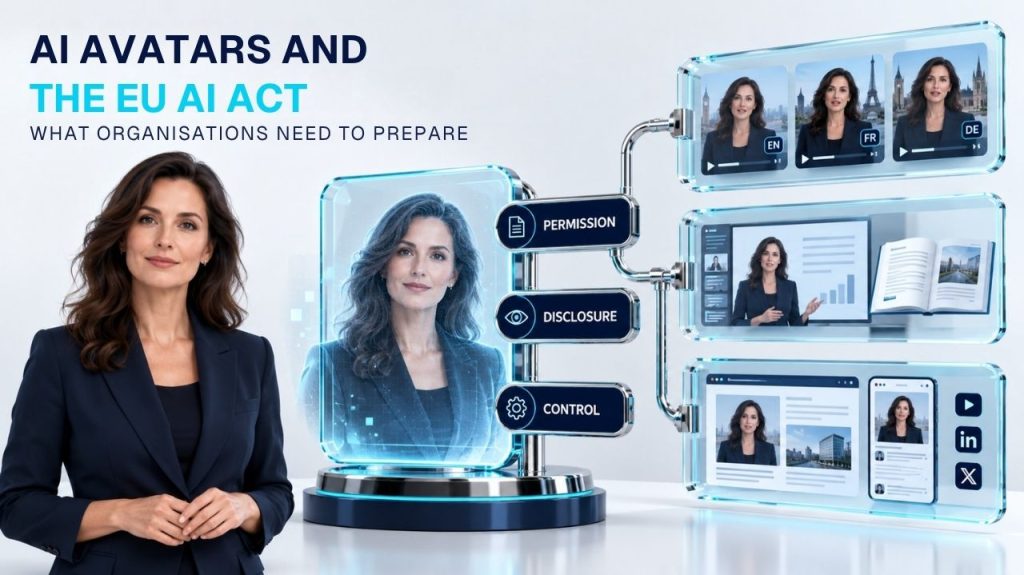
Insights / AI policy AI Avatars and the EU AI Act: What Organisations Need to Prepare Article 50 changes more than the disclosure line. It changes how organisations need to manage reusable digital identities. Olena Soinikova · Research & field notes · 30 September 2026 On this page The AI Act regulates the output, not the word “avatar” A compliant platform does not settle the publication decision Consent belongs to another layer of the system The difficult part appears after the first video Governance starts before generation What NGOs should pay particular attention to Article 50 of the EU AI Act has applied since 2 August 2026. For organisations producing AI video, one consequence is immediate: some decisions that used to sit entirely inside a communications workflow now have a compliance dimension. The visible part is disclosure. The more interesting part is what happens behind it. I work with AI content production across NGOs, EU-funded projects and SMEs through Soinikova Digital, with a team of four AI content creators. The production logic has changed quite quickly. An avatar created for one video rarely has to remain one video. The same digital presenter can return in another language, appear in social media edits and later be considered for training or an interactive service. At that point, the organisation is managing a reusable digital identity. This is where Article 50 becomes more useful as an operational signal than as another regulation to summarise. The AI Act regulates the output, not the word “avatar” There is no separate legal category for an “AI avatar” in the AI Act. For organisations publishing avatar video, the relevant analysis can instead lead to the definition of a deepfake in Article 3(60). The definition covers AI-generated or manipulated image, audio or video that resembles an existing person, object, place, entity or event and can falsely appear authentic or truthful. That produces quite different situations inside the same production software. A clearly synthetic presenter may sit differently from a digital version of a real director delivering a script that the director never recorded. Voice cloning matters because audio is covered by the definition. AI dubbing can create a more difficult case when the original speaker appears to deliver words or speak a language that was generated later. I find this distinction more useful than asking whether AI was involved. In most contemporary production workflows, that question tells very little. What matters is what was generated, who or what it resembles and how the audience is likely to understand what it sees. A compliant platform does not settle the publication decision Article 50 divides responsibility between different actors. Under Article 50(2), providers of generative AI systems have obligations concerning machine-readable marking and the detectability of synthetic outputs. Article 50(4) creates a different obligation for deployers where image, audio or video constitutes a deepfake: the artificial generation or manipulation has to be disclosed. Article 50(5) sets requirements around how and when that information reaches people. For a communications team, the practical distinction is straightforward. A technical marker embedded by a platform and a disclosure understood by the audience perform different jobs. This becomes less tidy once a real production process is involved. A script may be approved inside an NGO. An external creator generates the video. Somebody else produces a translated version. The communications manager publishes it, and three weeks later a consortium partner cuts 20 seconds from the original and uploads the extract to another social channel. There is no single “AI compliance button” travelling through that chain. The organisation therefore needs to know where its own responsibility begins and what happens to the relevant disclosure when content moves. Consent belongs to another layer of the system A real person’s avatar introduces a second issue that is easy to merge with transparency. An employee, trainer or external expert may have agreed to the creation of an avatar. That permission can matter for GDPR, contractual arrangements and national rules concerning image and voice rights. It does not remove the Article 50 analysis. Consent is absent from the Article 3(60) definition of a deepfake. Article 50(4) does not contain a general exemption for an avatar created with the represented person’s agreement. Operationally, I separate these questions. One concerns the organisation’s permission to create and use a digital representation. The other concerns what an audience needs to know when it encounters the resulting material. The separation becomes important when the first production brief changes. A person may approve an English training video. Six months later, the organisation wants a Greek version, a fundraising edit and several short videos for social media. Technically, producing them may take very little effort. The original permission may tell the organisation considerably less about whether those uses were actually authorised. This is one reason AI avatars should stop being treated as ordinary media files once they become reusable. The difficult part appears after the first video Consider a project that records an expert speaking in English. Later, AI is used to create a Danish version. The translated voice is synthetic and the lip movements are adjusted to make the delivery appear natural. The Danish video is then shortened for social media and distributed through project partners. Several decisions now sit inside what initially looked like localisation. The organisation needs a basis for using the person’s likeness and voice in the translated version. It also needs to examine the final output: if the expert appears to have personally recorded the Danish statement, the deepfake definition becomes relevant. Distribution creates another problem. A disclosure placed next to the original video on a project website may disappear when a partner downloads the file. A social platform can separate the video from its original description. An edit can remove the opening seconds where information was presented. The published version is therefore what matters operationally, rather than the master file sitting in a
Children and AI: The Rules That Matter When the Technology Keeps Changing
Insights / AI & Content Systems Children and AI: The Rules That Matter When the Technology Keeps Changing A practical framework for privacy, verification, relational AI, schoolwork, consent and family communication. Olena Soinikova · Research & field notes · 8 September 2026 On this page Age limits Privacy and identity Fluency and reliability Relational AI The disclosure rule Learning and schoolwork Creation and consent What AI displaces Ten family rules The parent’s role Sources In 2025, I wrote about children and AI mainly as a digital literacy problem. Children needed to understand that AI could make mistakes, that algorithms influenced what they saw, and that personal information required protection. I would write that article differently in September 2026. The technology has moved from recommendation systems and occasional chatbot use towards something more personal. Generative AI can hold a long conversation, remember context, create realistic images, imitate voices and respond to a child’s worries in language that sounds attentive and reassuring. The evidence around children has moved as well. UNICEF updated its Guidance on AI and Children to Version 3.0 in December 2025. The framework now explicitly addresses AI companions, children’s well-being and AI-generated sexual abuse material alongside established concerns about safety, privacy, transparency and discrimination. In June 2026, UNICEF published separate recommendations on AI chatbots and companions. Australia’s eSafety Commissioner has since reported research involving 1,950 children aged 10–17 and their experiences with AI assistants and companions. Working with AI professionally has made one thing unexpectedly clear to me at home. Adults tend to explain the system. Children need to know what to do at the moment when the system gives them something convincing, personal or uncomfortable. That has changed the way I think about AI safety rules for children. The rules need to survive the next software update. Age limits tell parents something important, but not everything My earlier article used a simple formulation: children under 13 should use AI with adult supervision. I would remove it now. There is no universal minimum age for “AI”. There are age conditions for particular services, in particular countries, under particular account arrangements. OpenAI’s current European Terms, for example, require users to be at least 13 or the minimum age required in their country to consent to use the service. A user under 18 needs permission from a parent or legal guardian. OpenAI also states that ChatGPT is not intended for children under 13; in an educational context involving children below that age, the actual interaction with ChatGPT must be conducted by an adult. Other platforms have their own rules. I do not think there is a clean universal answer to the age question. Terms of service can establish when an account may be used. They cannot tell a parent when a particular child is ready to recognise persuasion, protect somebody else’s privacy or notice when a chatbot is becoming too important. That is why I would check the current rules of a service before a child starts using it rather than put a permanent platform age table on the family fridge. The family principle has a longer useful life: before starting a new AI service, check whether it is appropriate and available for that child’s age and account. Privacy becomes harder to see inside a conversation Children usually understand that a password is private. A home address is also relatively easy to classify. Conversational AI makes privacy less obvious. A child can mention the name of a school, describe an argument with a friend, explain where the family is going at the weekend, discuss something about their health or upload a photograph to ask a seemingly harmless question. None of these interactions feels like filling in a database. That is precisely why the distinction matters. UNICEF’s child-centred AI framework treats children’s data and privacy as a specific requirement, rather than something that can be left to general digital literacy. For families, I think the practical boundary should include information about other people as well. There is another reason for extending the rule beyond names and passwords. Generative systems can do something with the material they receive. A photograph can be altered. A voice can be imitated. A classmate can be placed into an image they never agreed to appear in. UNICEF reported in February 2026 that, across research covering 11 countries, at least 1.2 million children aged 12–17 said their images had been manipulated into sexually explicit deepfakes during the previous year. That number changes the conversation about children’s images. Consent is no longer an abstract digital citizenship lesson. A child who understands “ask before using another person’s face or voice” has a rule that works across image generators, video tools and whatever arrives next. Fluency still creates a reliability problem The older version of my article compared AI with a very smart parrot. I still think the metaphor can work with a younger child, although I would not build the adult explanation around it. The more useful concept is fluency. Generative AI can produce a wrong answer in exactly the tone in which it produces a correct one. It can invent a source, misstate a historical fact or confidently explain something it has misunderstood. Children therefore need a verification habit before they need a technical explanation of hallucinations. What needs checking depends on consequence. An idea for a fictional monster can remain an idea. A quotation for homework needs a source. Health information or something that could materially affect another person requires a much higher level of caution. This is closer to the kind of AI literacy I want a child to develop: not permanent suspicion, but judgement about when an answer needs another source or another person. Relational AI changes the conversation at home This is the part I would add most substantially to the original article. In 2026, Australia’s eSafety Commissioner published research based on 1,950 children aged
Before You Produce an AI Avatar: What It Actually Means for People, Teams and Organisations
Insights / AI & Content Systems Before You Produce an AI Avatar: What It Actually Means for People, Teams and Organisations What to decide about representation, permissions, multilingual review and continuity before avatar production begins. Olena Soinikova · Research & field notes · 8 September 2026 On this page What an avatar is useful for HeyGen and the changing category A digital likeness as an asset Multilingual production Trust and transparency People, rights and platform control Accessibility in the brief Beyond the first video Planning before production AI Avatar Planning Checklist An organisation creates an AI avatar of one of its people. The first English video looks clear and professional. A few months later, the team needs the same message in four other languages. A partner asks whether it can use the avatar too. Some information in the original video needs updating. Then the person whose face and voice were used prepares to leave the organisation. This is usually the point when the interesting questions begin. Who can create another video, what can the avatar say, who checks the translations, does the original permission cover a partner organisation, and what happens to existing videos after the person leaves? If the organisation changes its AI platform, what exactly can it take with it? These are decisions about representation, trust, responsibility and continuity. For organisations using AI video across several projects or languages, an avatar is becoming more than a production shortcut. It can become a reusable communication asset that continues to speak on behalf of an organisation long after the first video has been published. That changes the planning considerably. The useful part is not that the avatar looks human The obvious advantage of an AI avatar is production. A traditional video connects the message to a recording session. If the script changes, somebody may need to record again. Another language means another version. Six months later, a figure changes and part of the process starts again. An AI avatar separates the presenter from that recording session. For training, project explainers, recurring information and multilingual content, this can be genuinely useful. I see the relevance particularly clearly in European project environments. One organisation may need to explain the same programme or service to audiences in several countries, while the communication budget was certainly not designed for separate filming in every language. This production advantage should not be confused with communication effectiveness. Research in educational settings has found comparable learning outcomes between AI-presented and human-presented video in some contexts, while participants can still prefer the human experience. The evidence does not give organisations a universal rule about which presenter works better. The task matters more. A recurring explanation of how a programme works has different requirements from a personal testimony. A training module is different from a leadership statement. A routine update that needs to exist in six languages has little in common with a message whose value comes partly from the fact that a particular person chose to deliver it personally. Sometimes an organisation needs a presenter. Other times it needs the presence of an actual person, and better visual realism cannot decide between the two. HeyGen shows how quickly the category has moved HeyGen is a useful example because the platform shows how much the idea of an AI avatar has expanded. I work with HeyGen and am a HeyGen Ambassador. This gives me a close view of the production possibilities, but I am increasingly interested in what happens around the technology once organisations start using it regularly. The original proposition was straightforward: provide a script, select or create a presenter and produce a video without arranging another filming session. The current model goes much further. HeyGen includes stock avatars, photo-based avatars and Digital Twins created from real people. A Digital Twin can reproduce a person’s appearance and voice for new scripts. The same production environment can also support multilingual video and localisation across more than 175 languages and dialects. At that point, the avatar is doing something more significant than replacing a filming session. A recognisable digital version of a person can be reused for new messages, updated without another recording and presented to audiences who speak different languages. That is a new capability for a communication team. It also shifts some of the work. Once a Digital Twin exists, somebody needs authority to use it. Future scripts need an approval route. New languages introduce new reviewers. A change in the person’s role may change what the avatar should represent. HeyGen provides the production capability. The organisation has to decide how that capability fits into its own communication system. The better these tools become, the more relevant that distinction becomes. A digital likeness is a different kind of asset The distinction is particularly important when an organisation moves from a stock presenter to a digital version of a real person. A stock avatar represents no employee in the organisation. A fictional character can be given a defined communication role. A digital likeness of a CEO, trainer, project manager or expert carries an identity that already exists outside the platform. Once that likeness has been created, a new appearance may no longer require a new recording. Someone prepares the script; the system generates the voice and image; the digital version of the person delivers words that the person did not personally record. For routine production, that is extremely convenient. It also changes what approval means. Approval of the original recording is one decision. Permission to generate future messages is a much broader one. Over time, the difference matters. The employee may change position. Another project may want to use the avatar. A partner organisation may ask to include it in its own communication. The next script may cover a subject that was never contemplated when the avatar was created. There is an audience dimension too. A digital likeness can imply expertise, personal