Review audiences, languages, approvals, channels and content infrastructure.
Olena Soinikova · Research & field notes ·
Then somebody asks for the latest approved project description.
Three versions appear in the shared drive. The Greek translation was made from an older English text. Nobody is certain whether the participant photographs can be reused. The colleague with administrator access to the website has changed jobs.
The communication plan still exists. So do the website and social accounts. The operating process is less certain.
I see this distinction particularly clearly when several EU-related projects are running at the same time. Communication can look organised at planning level while depending operationally on one colleague remembering where something is stored, which translation is current or who needs to approve a publication.
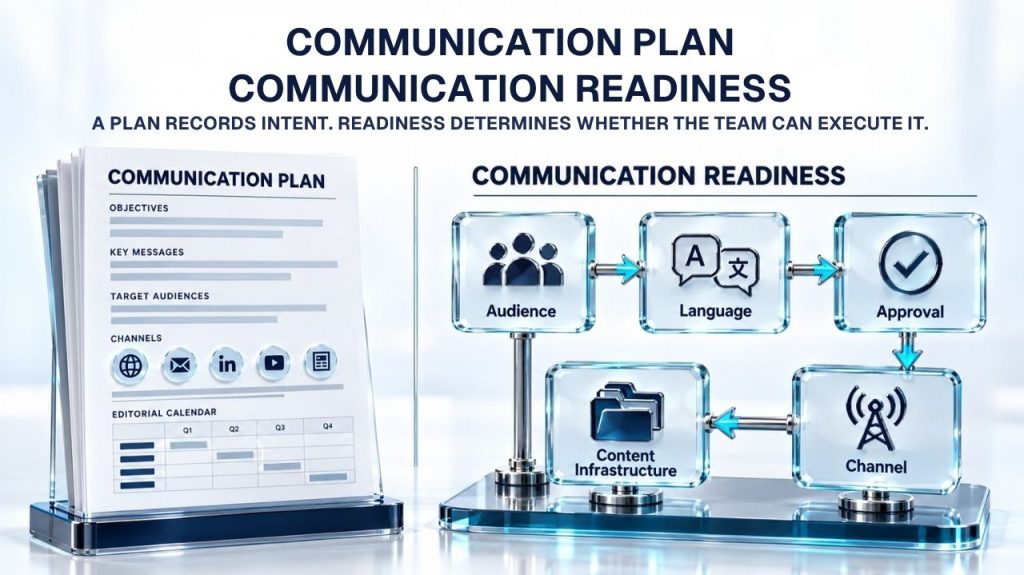
I call this communication readiness. In practical terms, it means that a project can produce, approve, deliver, maintain and preserve its communication without reconstructing the process each time.
The term is my working framework, not an official EU programme concept. Its components, however, sit underneath many of the communication requirements and recommendations already found across Horizon Europe, Erasmus+, Interreg and other EU programmes.
EU-funded projects already operate within communication and visibility requirements.
All recipients of EU funding have a general obligation to acknowledge the origin of that funding and ensure its visibility. Depending on the programme, projects can also face specific requirements concerning communication activities, websites, social media, events, media relations and other forms of public visibility. The European Commission explicitly advises beneficiaries to check programme-specific funding rules and financing agreements for the details.
Horizon Europe adds an important distinction between communication, dissemination and exploitation. Communication makes the project, its activities and results visible; dissemination makes results available to people who can use them; exploitation concerns their actual use in further research, products, services, policy or other applications.
Erasmus+ takes another route. Its #CommsJourney guidance provides beneficiaries with a step-by-step framework for communicating projects and their results.
These frameworks matter. I would not replace them with another homemade compliance system.
The operational problem starts one level below them.
A communication plan can say that the project will communicate with policymakers, practitioners, SMEs and citizens through a website, newsletters, events and social media. It may still leave unanswered which municipal network can actually reach the relevant policymakers, who checks the Danish version of a new result summary, or whether a routine event reminder needs approval from seven partners.
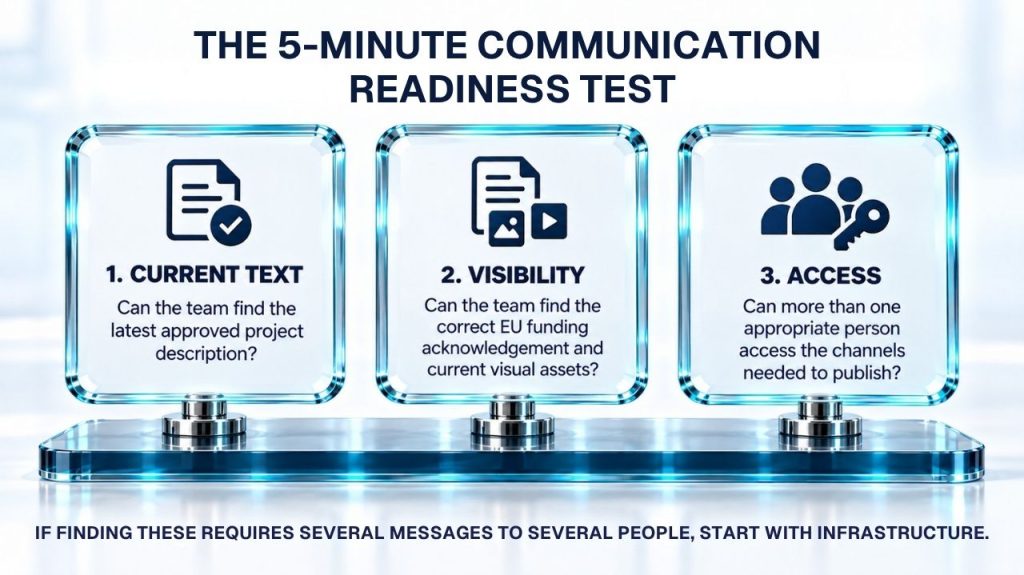
A useful five-minute test is to ask a colleague who did not write the communication plan to find the current approved project description, the correct funding acknowledgement and the latest reusable visual assets.
If this requires several messages to several people, I would start there before adding another communication activity.
“Policymakers”, “SMEs”, “stakeholders” and “the general public” appear regularly in project communication plans.
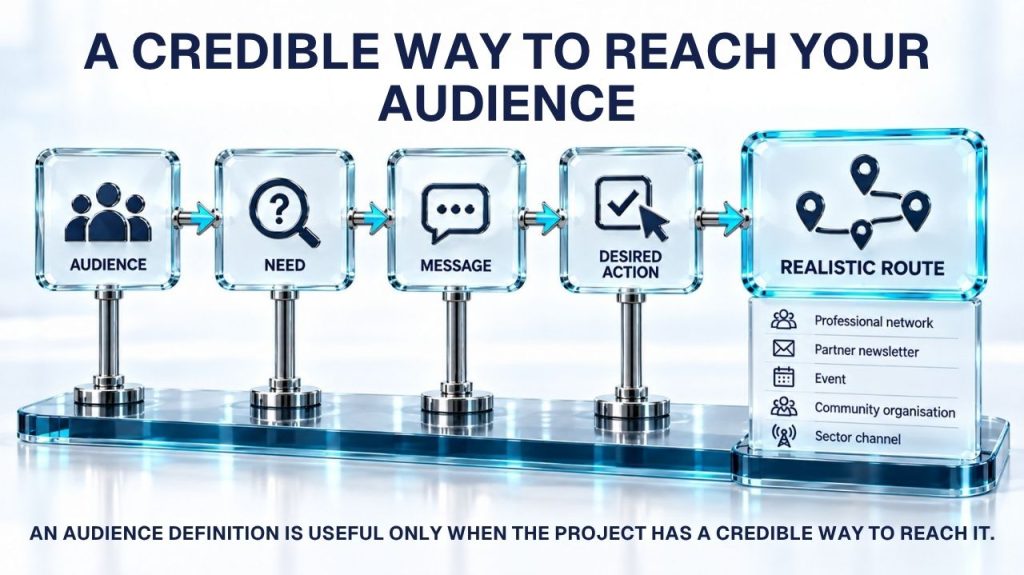
They are categories. Communication starts when the project can connect those categories to an actual need and an actual route.
For one project, a professional association may provide better access to SMEs than a new Instagram account. Municipal actors may already sit inside a partner’s regional network. A community organisation can be more useful for reaching a specific group of citizens than another digital campaign.
This is also where communication and stakeholder engagement begin to separate. Making somebody aware that a project exists is different from involving that person in an activity, getting them to use a result or bringing them into a policy discussion.
I use a simple chain when reviewing this:
Audience → need → message → desired action → realistic route
The final part is easy to underestimate. A carefully described target audience that the consortium has no credible way to reach remains largely theoretical.
The same principle applies to channel selection. A project should not start with “Should we create LinkedIn, Instagram and Facebook?” It should start with where the relevant people already receive information and which of those routes the consortium can realistically access.
European projects create an obvious temptation to translate everything. That is rarely the most useful starting point.
There is no general rule requiring every EU-funded project to translate every communication asset into every partner language. Programme-specific obligations still need to be checked. Operationally, language decisions should follow the audience: who needs this information, and in which language will they actually use it?
Once several versions exist, a different problem appears.
The core project description changes in English. The website is updated. The Greek version remains unchanged. A partner translates an older PDF into Danish. Six months later, three technically correct documents describe the same project differently.
That is a version-control problem disguised as a translation problem.
For multilingual projects, I want to see one identifiable master version, agreed terminology for programme names and recurring technical terms, and a defined review route for every language that matters.
Machine translation can reduce the first production step. Responsibility for meaning remains with the project.
A concrete starting point takes about twenty minutes: identify the source-of-truth project description, add a version number and date, then list the active language versions beside it. Each needs a defined review route when the master changes.
This becomes even more relevant as projects introduce AI-supported translation, synthetic voice and multilingual video. Production capacity is expanding faster than many consortium review processes. Generating another language version may take minutes; establishing whether the terminology, pronunciation and meaning are suitable for publication still requires a decision.
One of the quieter ways to slow a consortium is to make every publication everybody’s decision.
A routine event reminder, a summary of a new project result and a participant story involving personal information carry different consequences. Their approval routes should reflect that.
There is no universal European Commission workflow requiring every social post to pass through author, work-package leader, coordinator and the entire consortium. Specific Grant Agreement and programme requirements still apply, particularly around results, rights, personal data and communication with significant external exposure.
For Horizon Europe projects, dissemination of results also has its own obligations and should not be confused with routine project communication.
Operationally, I find approval classes more useful than one workflow for everything.
Routine communication can have a short route. A new result may need its content owner and communication lead. Material involving personal information, sensitive claims or substantial external exposure may require additional review.
Data protection deserves particular attention here. REA guidance explicitly treats personal data used in communication activities, including photographs, videos and events, as something projects need to manage deliberately through appropriate records, notices, consent where relevant and secure handling.
Take three real items planned for the next month: an event reminder, a result announcement and a participant story. If the team cannot say who prepares, checks and finally clears each one, there is useful work to do before the deadline arrives.
A substitute also matters. A workflow that exists only while one particular colleague is available is still a dependency.
Opening a social account takes minutes. Maintaining one for three years is a different proposition.
Official guidance does not turn every available platform into a project requirement. REA, for example, treats social media as one communication tool while making clear that it does not replace the required web presence for the Horizon projects it manages; that web presence may itself be a dedicated project website or part of an existing website.
This distinction matters because existing infrastructure can be more valuable than a new project account.
A partner newsletter with an established professional audience may outperform a project page starting from zero. A sector network can already contain the practitioners the project needs. Events, municipal networks and programme channels may solve communication problems that another social profile cannot.
When reviewing a channel, I therefore look at four fairly ordinary things: who it is for, what role it serves, whether the project can maintain it, and whether access survives a staff or supplier change.
The access question tends to receive little attention at kick-off. It becomes very practical when an external contractor turns out to hold the only administrator account.
Metrics need the same discipline.
Reach indicates exposure. Registration, download, enquiry or use of a project result tells the project something else. A small set of indicators connected to the communication objective is usually more useful than an elaborate dashboard that produces numbers nobody uses to make a decision.
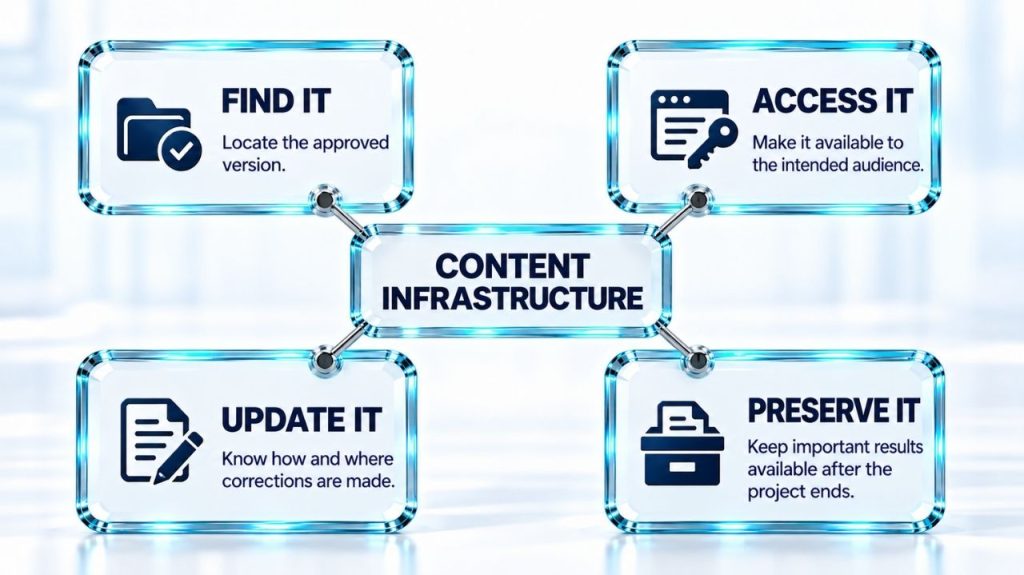
I use “content infrastructure” to describe the shared places, rules, access arrangements and responsibilities that allow a project to find, create, approve, publish, update and preserve its communication materials and results.
This does not require expensive software.
For many small and medium projects, a shared folder, simple tracker, current templates, permissions records and clear responsibility for keeping them current may be entirely sufficient.
What matters is what happens on an ordinary working day.
Can a new team member find the approved project description? Is the current logo package obvious? Can somebody establish whether a photograph may be republished? Is the final result distinguishable from a draft? Does more than one person know who controls the website?
Then comes the question that tends to arrive much later: what survives after funding?
Project communication naturally concentrates on producing material during implementation. Results have a longer problem. Websites close. Hosting expires. Staff leave. Links break. The project may technically have published a result while making it progressively harder for anyone outside the consortium to locate or use.
A PDF uploaded to a repository is evidence that a file was published. Whether someone outside the consortium can find, understand and use it is a separate question.
This is where dissemination and exploitation become relevant rather than interchangeable labels. Under Horizon Europe, dissemination concerns sharing results with people able to use them, while exploitation concerns their use in further research, products, services or policy.
For a practical infrastructure test, I pick one current result and follow it through four stages: find it, access it, update it and preserve it.
The exercise usually exposes more than another review of the folder structure.
Communication readiness should not become another administrative industry inside the consortium.
A small partnership working in one or two languages with a limited set of outputs may operate perfectly well with a carefully managed shared drive, a basic tracker and clear responsibilities.
A multilingual consortium publishing public-facing results across several countries has a different coordination problem.
The preparation should reflect that difference.
This principle of proportionality also matters because EU programmes should not be collapsed into one universal set of communication rules. Horizon Europe, Erasmus+, Interreg and Digital Europe have different programme architectures, while individual calls and Grant Agreements can add further requirements.
The European Commission itself advises recipients to check the applicable programme, funding rules and financing agreement for programme-specific adjustments to communication and visibility requirements.
A readiness check therefore cannot certify compliance.
Its job is more practical: once the project knows what it is required to do and what it wants its communication to achieve, can the team execute it without repeatedly improvising the process?
A communication plan describes what a project intends to do.
Readiness becomes visible on an ordinary Tuesday when a partner needs an approved description in another language before 15:00, the usual approver is travelling, and the website needs to be updated before an event.
At that point, another paragraph in the communication strategy is unlikely to solve much.
The team needs to know which text is current, how it is approved, who can check the language, where it should be published and whether the necessary access is available.
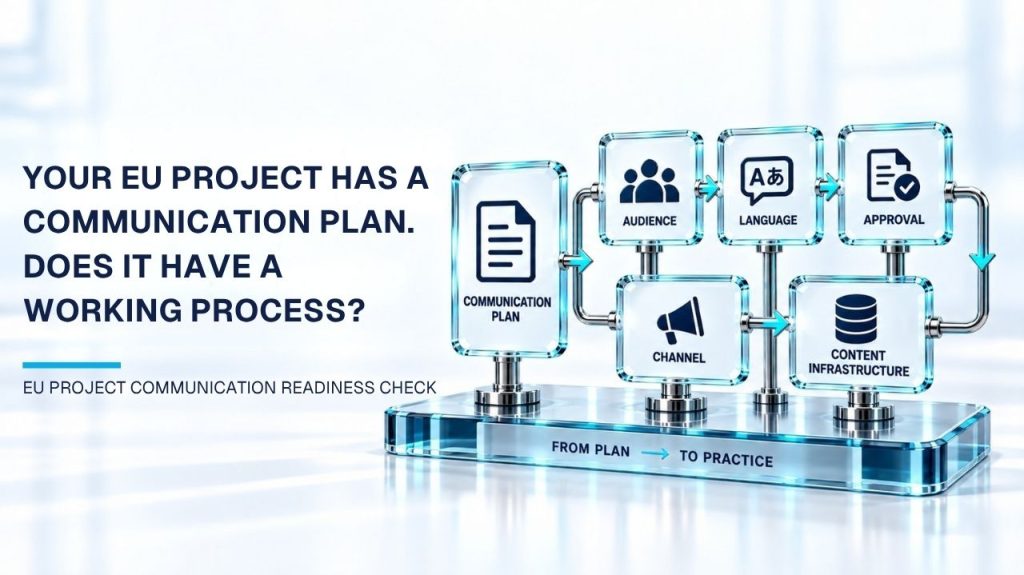
I have turned those operational questions into the EU Project Communication Readiness Check, a short internal review covering audiences, languages, approvals, channels and content infrastructure.
It is deliberately not a compliance score. A small project can have a simple communication system and be well prepared. A much larger consortium can have twenty pages of communication planning and still depend on undocumented decisions held by individual people.
In practice, those gaps are where I would start before adding another communication activity.
Review audiences, languages, approvals, channels and content infrastructure.
A short practical resource for checking whether your project has the people, access, approved materials and working processes needed to communicate consistently.
The communication readiness framework in this article is my operational interpretation, not an official European Commission methodology. Programme-specific obligations should always be checked against the relevant call documents, signed Grant Agreement, annexes and beneficiary guidance.
European Commission — Communicating and raising EU visibility General EU guidance on funding acknowledgement, visibility, communication activities, the EU emblem and programme-specific requirements.
European Research Executive Agency — Communicating about your EU-funded project Practical guidance covering project communication, web presence, social media, EU funding acknowledgement, data protection and related communication responsibilities.
European Research Executive Agency — Dissemination and exploitation Useful for distinguishing communication from dissemination and exploitation under Horizon Europe and for understanding the role of project results.
REA — Disseminating and exploiting results: starter kit A 2025 practical resource for Horizon Europe research and innovation projects working with dissemination and exploitation.
European Commission — How to communicate your project / Your Project #CommsJourney Step-by-step communication guidance for Erasmus+, Creative Europe and European Solidarity Corps beneficiaries.
For Interreg projects, consult Regulation (EU) 2021/1059 together with the manual and communication requirements of the specific Interreg programme. Requirements should not be inferred from another Interreg programme.
For every project, the signed Grant Agreement, relevant annexes, call conditions and programme-specific beneficiary guidance remain the authoritative sources for the obligations that apply.
We help EU-funded projects turn communication plans into workable systems for multilingual content, approvals, publishing and long-term access to project results.
I use a free EU database to read commercial intentions before they become commercial announcements.
Olena Soinikova · August 24, 2026

While everyone else waits for the official call to open, the real game is already visible in draft Work Programmes, CORDIS consortium graphs and TED velocity spikes.
Olena Soinikova · August 10, 2026

Why Artificial Intelligence Is More Than Just a Toy — and How We Can Teach Our Children to Use It Wisely.
Olena Soinikova · Jube 06, 2026

AI Content Systems for European Organisations
Building scalable communication infrastructure for NGOs, EU-funded projects, and SMEs.
© 2026 Soinikova Digital. All rights reserved.
Tell us what your team needs to produce over the next three months. We will review the formats, languages, deadlines and recurring workload, then suggest an appropriate production scope.