
October 4, 2026/
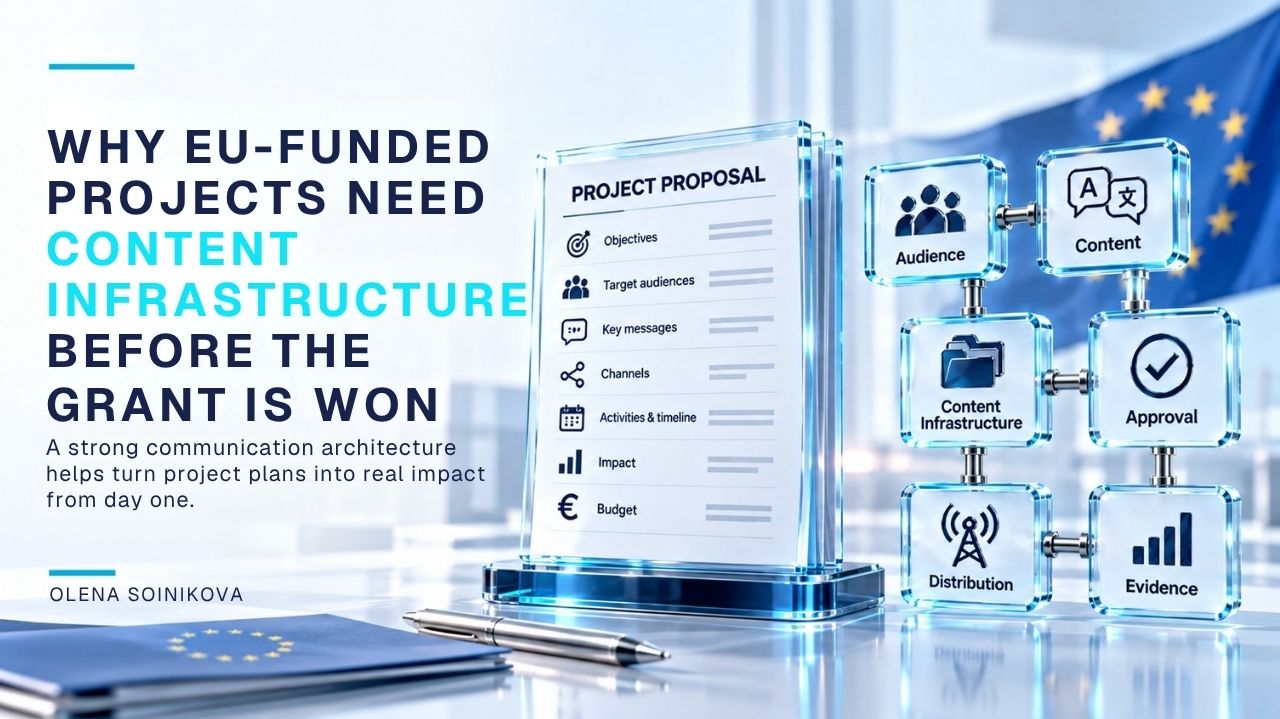
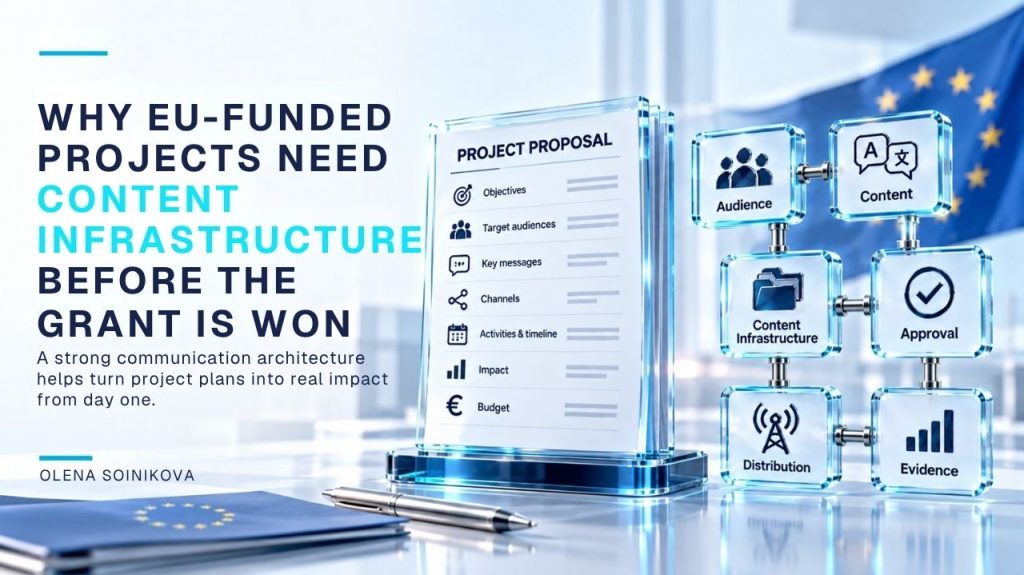
Insights / EU project communication Why EU-Funded Projects Need Content Infrastructure Before the Grant Is Won The communication problem in...
The communication problem in an EU-funded project usually becomes visible after the proposal has succeeded.
Olena Soinikova · Content Infrastructure · 04
The consortium has defined target groups and communication activities. Responsibilities have been distributed across work packages. Deliverables have deadlines. Somebody has estimated the communication budget and described how results will reach the relevant audiences.
Then implementation starts.
A pilot finishes in one work package, while the useful numbers sit with another partner. Photographs from an event are stored locally. The technical explanation appears in a deliverable that reaches the communication team several weeks later. By the time somebody decides that there is material worth publishing, part of the context has already disappeared.
Working across several EU-related projects at the same time has made this gap increasingly visible to me.
Projects rarely lack communication channels. The weakness is usually further upstream: the proposal defines what communication should achieve without necessarily designing how project knowledge will move between partners once delivery begins.
I use “content infrastructure” for that operating layer.
And I think it needs to be designed before the grant is won, even though most of its weaknesses will only become visible afterwards.
Content infrastructure is not a term used in EU funding rules.
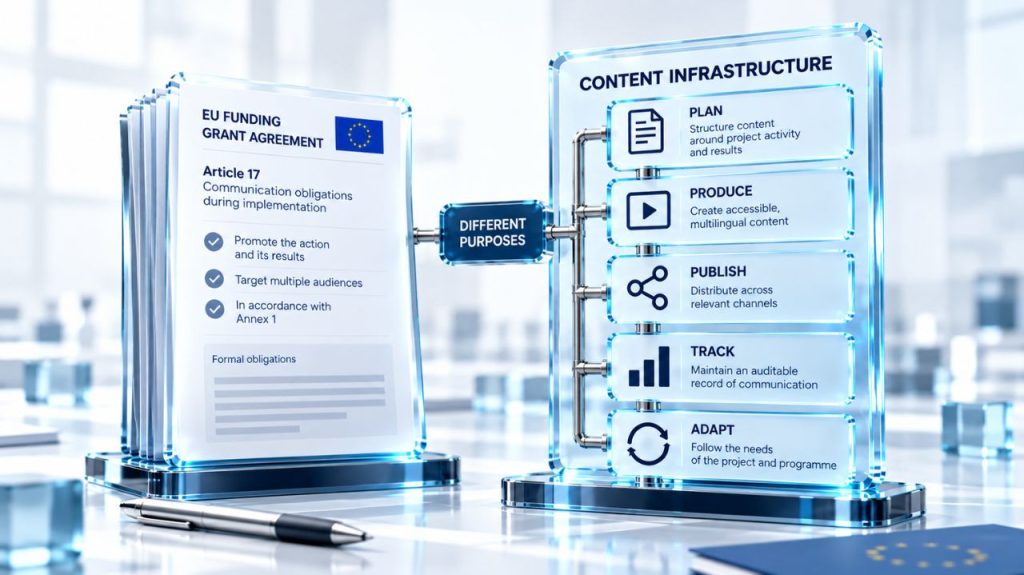
I define it as the organisational and technical system that converts project activity and results into approved, accessible and traceable material throughout implementation.
The formal obligations come from somewhere else.
Under Horizon Europe, Article 17 of the Model Grant Agreement requires beneficiaries to promote the action and its results through targeted information to multiple audiences, in accordance with Annex 1. Horizon guidance treats communication as an activity that starts with the action and continues during implementation.
There is another distinction that matters once production begins. The Commission treats communication, dissemination and exploitation as different activities.
Communication concerns the project, its work and results. Dissemination makes results available to people who may use them. Exploitation is concerned with actual uptake in research, services, policy, products or other applications.
The administrative language hides a fairly practical difference.
Publishing a LinkedIn update about a methodology communicates that the work exists. A practitioner finding the methodology, understanding it and being able to apply it is a dissemination outcome. The project may need both, but the production logic behind them is different.
Erasmus+ and Digital Europe structure these responsibilities differently, and individual Grant Agreements add their own commitments. There is no horizontal EU rule requiring every funded project to maintain a separate website or publish a fixed number of social posts. Translation into several languages is not a universal requirement either.
The operating system therefore has to follow the actual project.
European Court of Auditors Special Report 09/2026 contains a useful example of what can happen when activity and dissemination become disconnected.
The audit covered innovation projects under EIP-AGRI/CAP, not Horizon Europe, Erasmus+ or Digital Europe. I would not use its findings to estimate performance in those programmes. The failure mechanism is still worth examining.
Of 53 projects in the relevant sample, 49 had expenditure for communication and dissemination. Only 28 published results and shared the knowledge they had created.
In a Spanish sample examined by the auditors, dissemination-related expenditure ranged from approximately €40,000 to €79,000 per project and reached as much as 17% of project costs. Six of the ten projects disseminated substantial results considered useful to other practitioners.
The auditors also fou
nd cases where project websites disappeared or contained little information about achieved results. Reporting could arrive years after project completion.
This is more interesting to me than a general argument about communication budgets.
The projects had spent money on communication. The weak point appeared in the transfer of results.
A consortium can publish regularly and still make its knowledge difficult to find or use. More output does not repair that connection.
This is where consortium structure starts to matter.
EU projects are organised around work packages because the work itself needs ownership. Communication has another organising principle: material has to make sense to a particular audience at a particular point in the project.
The useful information is therefore often sitting in the wrong organisational place.
A technical partner completing a pilot may quite reasonably consider the task finished once the technical work and required documentation are complete. From a communication perspective, several things are still missing. Somebody needs the relevant facts while they are current, an explanation that works outside the technical team and enough context to decide whether the result belongs in public communication or dissemination.
Add several countries and organisations, and this becomes a coordination issue rather than a writing issue.
The existence of a communication work package does not resolve it. Formal responsibility can sit with one partner while the source material remains distributed across the consortium.
CommuniCity gives a useful public example of a project that treated communication as a recurring process. The Horizon Europe project, Grant Agreement 101070325, received approximately €5 million in EU funding and ran from September 2022 to August 2025.
Its public documentation included an early Communication Plan, later updates and Communication Performance Reports during implementation. Planning was followed by monitoring and review rather than ending with the submission of the first communication deliverable.
I find the repetition more significant than the individual documents.
A plan written at the beginning of a three-year project cannot know everything that will be worth communicating in year three. A mechanism for revisiting the plan can.
Periodic reporting exposes weak information flows very efficiently.
An event happened six months earlier. A partner published something locally. Another organisation distributed project material through its own network. Then reporting starts and somebody needs the link, date, audience information or evidence of reach.
The consortium reconstructs its own activity from inboxes and browser histories.
I have seen enough project administration to consider this an infrastructure problem rather than an administrative inconvenience.
The alternative can be very simple. When material is published, the project retains the evidence it will later need. The precise information depends on the programme and Grant Agreement. It may include a URL, publication date, audience or the relevant project indicator.
Horizon Europe uses continuous and periodic reporting. Digital Europe projects can have structured reporting around communication activities and indicators. Erasmus+ requirements depend on the action, with the Project Results Platform providing an additional public results layer for relevant projects.
I would therefore treat evidence capture as part of the content process rather than a separate exercise performed before a reporting deadline.
It changes the nature of reporting from reconstruction to retrieval.

There is no reason for a small Erasmus+ partnership to reproduce the communication architecture of a €5 million Horizon consortium.
A shared repository and clear ownership may be sufficient. Larger projects can need a defined route from work packages into production, approval and partner distribution, with a more deliberate system for evidence.
I would decide the level of infrastructure from the coordination problem.
A three-partner project operating in one language has one problem. A consortium working across several countries, work packages and target groups has another. Rights, confidentiality or localisation can add complexity depending on the work being delivered.
The technology is secondary.
Buying another content platform does very little if nobody knows who should send information from a completed pilot to the person responsible for dissemination.
That connection is the infrastructure.
EU project communication also has an awkward habit of outliving the organisational structure that produced it.
Consortia close. Staff move. Contractors lose access. Domains and social accounts still exist.
Some programme obligations can continue beyond the funded period. Horizon Europe can include continuing exploitation responsibilities. Erasmus+ gives varying weight to sustainability and continued use of results, depending on the action. Individual Grant Agreements can be more specific.
TWIN-PEAKS, a Horizon 2020 Twinning project, provides a neat example. Its project commitments included maintaining the website for three years after completion.
That is a project-specific obligation, not a rule for every EU-funded website.
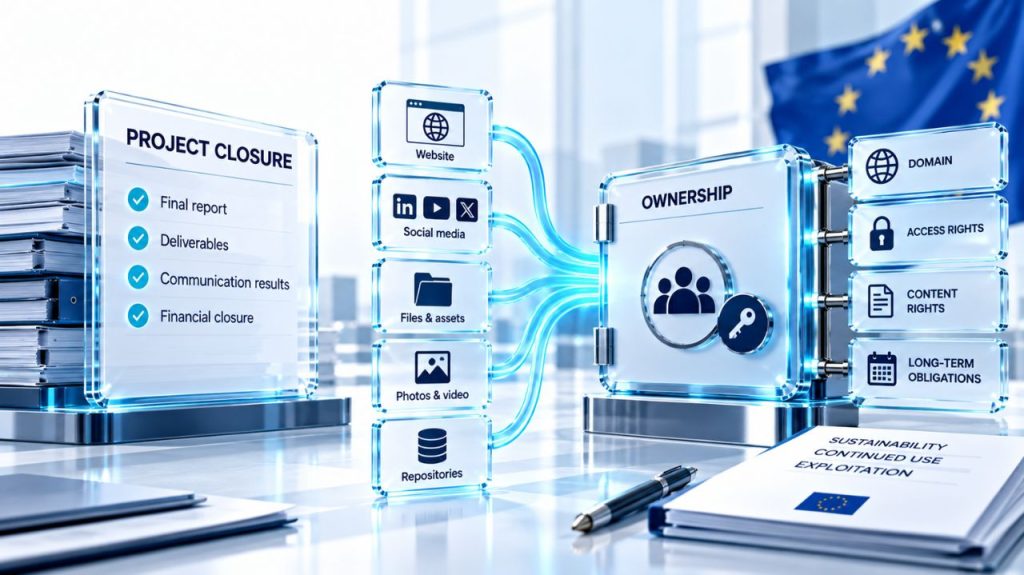
It also exposes a practical question that is easy to postpone: who owns the content system when the project organisation that maintained it no longer exists in the same form?
Domains, repositories and public deliverables need an owner. So do the rights attached to photographs or video that may continue circulating after the final report.
I do not think there is one clean architecture for this. A research consortium producing exploitable technical results and a small Erasmus+ partnership should make different decisions.
The decision itself should not be left until the final month.
When I look at project communication as infrastructure, I start with the movement of information rather than the publication calendar.
Something happens inside the project. The people closest to that work know why it matters. That knowledge has to cross an organisational boundary before it can become communication or dissemination material.
For some projects, the system supporting that transfer can remain deliberately small. Others need defined ownership, approval routes, localisation processes and a reliable evidence record.
EU funding rules establish the obligations. Annex 1 and the project plans make many of them specific.
The consortium still has to build the mechanism that connects those commitments to everyday work.
This is the part worth designing immediately after the grant is won. Not because an EU programme asks for something called content infrastructure, but because several years of project knowledge are about to start moving between organisations.
Without a system for that movement, communication tends to become a sequence of individual production tasks.
With one, project activity has a better chance of becoming something that can still be found, understood and used after the work package has closed.
The requirements discussed in this article vary by programme, action and individual Grant Agreement. These are the primary sources I would use when designing communication and dissemination infrastructure for an EU-funded project.
The Model Grant Agreement is the starting point for understanding the contractual framework behind communication, dissemination, visibility and exploitation obligations. Article 17 is particularly relevant to communication and visibility, while the project’s Annex 1 translates programme requirements into project-specific commitments.
The Programme Guide provides the broader implementation context for Horizon Europe projects, including communication, dissemination and exploitation of results. It is useful for understanding why these activities need to be considered throughout the project lifecycle rather than treated as end-of-project promotion.
A practical Commission resource covering communication around EU-funded actions, including visibility of EU funding and the use of the EU emblem. It is useful when translating Grant Agreement obligations into actual communication materials.
https://commission.europa.eu/resources-partners/european-commission-visual-identity_en
The Programme Guide is the primary reference for Erasmus+ requirements. Communication, dissemination, sustainability and the use of project results depend on the action, so the relevant section should always be read together with the project’s Grant Agreement and approved application.
https://erasmus-plus.ec.europa.eu/programme-guide
The platform provides access to funded Erasmus+ projects and their results. For project teams, it is also a useful reference for understanding how results remain discoverable beyond an organisation’s own website and social media channels.
https://erasmus-plus.ec.europa.eu/projects
The European Commission’s Digital Europe resources provide programme documentation, calls and implementation context. Communication and dissemination requirements should be checked against the specific call documentation and Grant Agreement rather than assumed from other EU programmes.
https://digital-strategy.ec.europa.eu/en/activities/digital-programme
CORDIS provides project and results information for EU research and innovation programmes. It is particularly useful for examining how funded projects document outputs, public deliverables and results over time.
This report provides an important counterpoint to communication planning. In the projects examined by the auditors, expenditure on communication and dissemination did not consistently translate into effective publication and transfer of project results.
The report concerns EIP-AGRI/CAP innovation projects and should not be generalised to Horizon Europe, Erasmus+ or Digital Europe. Its value for this article is the operational failure pattern it documents: communication activity and useful dissemination are not automatically the same thing.
CommuniCity is a useful practical reference because its public documentation shows communication planning and performance monitoring across the project lifecycle rather than only an initial communication plan.
Project information and public results can be checked through CORDIS:
https://cordis.europa.eu/project/id/101070325
Programme-level guidance is only the first layer.
For an individual project, I would always check the applicable Grant Agreement, Annex 1 / Description of Action, communication and dissemination commitments, relevant deliverables and programme-specific reporting requirements before designing the content workflow.
The EU rules establish the obligations. The project documents establish much of the specific scope. Content infrastructure is the operating layer the consortium builds around them.
We help EU-funded projects turn communication plans into workable systems for multilingual content, approvals, publishing and long-term access to project results.
Insights / EU project communication Why EU-Funded Projects Need Content Infrastructure Before the Grant Is Won The communication problem in...

Insights / AI policy AI Avatars and the EU AI Act: What Organisations Need to Prepare Article 50 changes more...

Insights / AI & Content Systems Children and AI: The Rules That Matter When the Technology Keeps Changing A practical...

AI Content Systems for European Organisations
Building scalable communication infrastructure for NGOs, EU-funded projects, and SMEs.
© 2026 Soinikova Digital. All rights reserved.
Tell us what your team needs to produce over the next three months. We will review the formats, languages, deadlines and recurring workload, then suggest an appropriate production scope.